
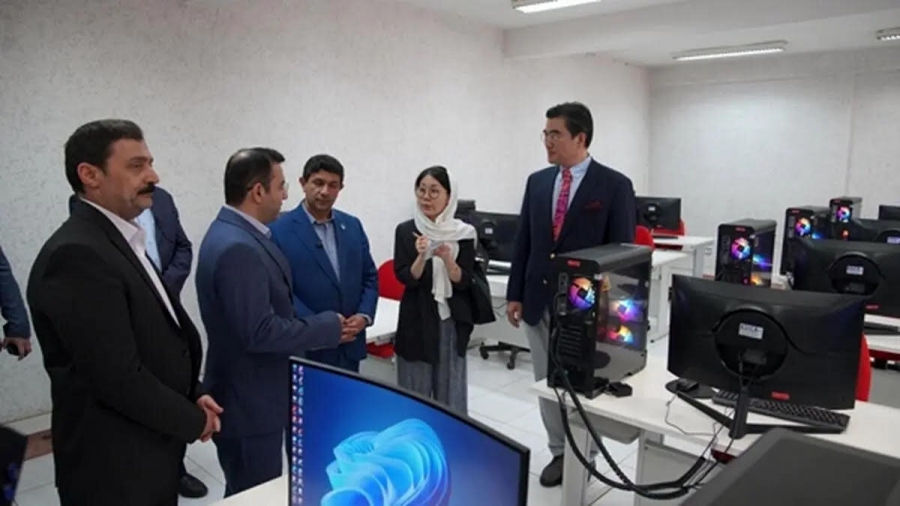
The Secretary-General of the Iranian National Committee for UNESCO also spoke, noting that this project is the result of effective cooperation between UNESCO, the Ministry of Foreign Affairs, the Technical and Vocational Training Organization, and other relevant institutions. He acknowledged that the project is built on three main axes: empoering instructors, renovating and equipping workshops, and expanding skill training for youth.
Hassan Fartousi, referring to the project's launch in 2025 and its implementation over a four-year period, added: Despite some challenges and interruptions due to regional conditions, this project has continued without stopping and has now entered the operational phase.
* Capacity-Building Beyond Political Challenges
The Advisor of Iran to the United Nations, speaking at another part of the ceremony, pointed to the role of the Ministry of Foreign Affairs in facilitating and accelerating this project and noted: After years of delay, technical negotiations between the Iranian, Korean, and UNESCO parties have reached a conclusion, and project implementation has resumed.
Ali Hajilari emphasized: This cooperation is not merely an equipment project; it is a project for capacity-building and soft technology transfer, and it should not be halted due to political challenges.
Other officials also stressed that this cooperation is a successful example of synergy among national and international institutions, including the South Korean Embassy, KOICA, the UNESCO office in Tehran, the Iranian National Commission for UNESCO, the Ministry of Cooperatives, Labor and Social Welfare, and the Technical and Vocational Training Organization.
According to them, this project has opened a new path for skill enhancement, instructor training, development of new technologies, and strengthening the role of youth and women in the country's skill ecosystem.
The project also includes equipping and upgrading several specialized fields, including design and sewing, information and communication technology (ICT), multimedia content production, agriculture, and construction industries. In addition, it encompasses programs such as training managers in Singapore and Malaysia, instructor training courses in South Korea, youth skill camps, and development programs extending until 2026.
According to this report, the unveiling of the project can be seen as a symbol of the linkage between diplomacy, skill training, and human development—a connection that the officials present at the ceremony evaluated as a successful model for future cooperation at both the national and regional levels.
During the event, a message from the new director of the UNESCO office in Iran was read out, and a report on the progress of the Technical and Vocational Training Instructor Training Center upgrade project was presented by the project manager, covering the period from the beginning to the present.